
To rank in AI Overviews, create content that answers a specific question directly in the first 40-60 words, back it with original expertise, structure it with clear headings, and make sure Google can crawl and understand your page. There is no special markup for AI Overviews. The pages that get cited are the clearest and most trustworthy answers to a query.
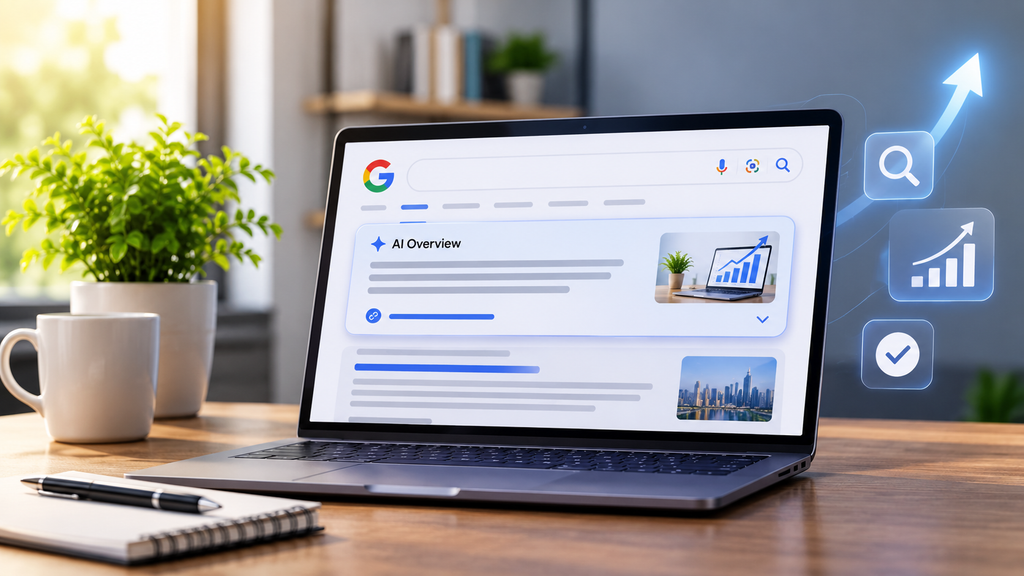
What Are AI Overviews?
AI Overviews are AI-generated summaries that appear at the top of some Google search results. They combine information from multiple web pages and link to the sources they used. When your content is cited there, your brand is seen before searchers even scroll to the regular results.
Does Ranking in the Top 10 Still Matter?
Yes. Pages that already rank well in organic search are far more likely to be used as sources. AI Overviews build on Google’s existing index, so relevance, authority, and a good user experience remain the foundation of any strategy to rank in AI Overviews.
1. Answer the Question Immediately
Place a direct, self-contained answer right below your heading, then expand with detail. AI systems favor passages they can lift cleanly without needing surrounding context.
For example: A conversion rate is the percentage of visitors who complete a desired action, such as a purchase or sign-up. It is calculated by dividing conversions by total visitors and multiplying by 100.
2. Use Question-Based Headings
Write your H2s and H3s the way people actually search, such as “What is email marketing?”, “How much does SEO cost?”, or “SEO vs PPC: which is better?” Use Google’s “People also ask” box, autocomplete suggestions, and Search Console queries to find the exact phrasing your audience uses.
3. Keep Paragraphs Short and Scannable
Limit paragraphs to two to four sentences. Use numbered lists for processes, bullet lists for features, and tables for comparisons. Structured content is easier for Google to extract and summarize.
4. Show Real Experience and Expertise
Google rewards content that demonstrates first-hand knowledge. Strengthen your pages with:
- Original examples, case studies, and results from your own client work
- Screenshots and data you collected yourself
- A named author with a short bio and credentials
- Sources for every factual claim
Generic, rewritten content is the least likely to be cited.
5. Cover the Topic Thoroughly
Answer the main question and the related questions around it. If you write about email marketing, also cover tools, costs, benchmarks, and common mistakes. Pages that address a topic’s full set of sub-questions are more likely to be pulled into AI-generated answers.
6. Get the Technical Basics Right
Technical health decides whether Google can use your content at all.
- Indexability: Make sure the page isn’t blocked by robots.txt or a noindex tag.
- Speed and mobile usability: Pass Core Web Vitals.
- Structured data: Add Article, FAQPage, Organization, and Person schema. It doesn’t guarantee inclusion, but it helps Google understand your content.
- Clean HTML: Use one H1 and a logical H2/H3 hierarchy.
- Internal links: Connect related posts to build topical authority.
7. Build Authority Beyond Your Website
Brand mentions, quality backlinks, customer reviews, and an active presence on LinkedIn, YouTube, and industry publications all strengthen the trust signals that influence which sources get cited.
Common Mistakes to Avoid
- Burying the answer under a long introduction
- Keyword stuffing instead of writing naturally
- Publishing thin, AI-generated content with no original input
- Never updating old posts, even though freshness matters for many queries
- Ignoring search intent by writing what you want to say instead of what people are asking
Frequently Asked Questions
Can I optimize for AI Overviews directly?
Not with a tag or setting. You optimize by making your content the clearest, most credible answer to the query.
Do AI Overviews reduce website traffic?
For simple informational queries, they can. That’s why it pays to target topics where users still need depth, tools, or expert guidance, and to make sure your brand is cited as a source.
How long does it take to rank in AI Overviews?
There is no fixed timeline. Pages that are already indexed and ranking can be picked up quickly after improvements, while newer sites usually need time to build authority first.
Should I still invest in traditional SEO?
Yes. Traditional SEO and AI Overview optimization overlap heavily, and strong organic rankings directly feed AI visibility.
Final Thoughts
To rank in AI Overviews, lead with a clear answer, support it with real expertise, structure it for easy reading, and keep your site technically sound. Start by updating your best-performing posts, then apply the same approach to every new piece of content you publish.