
Artificial intelligence is transforming the business world. Companies are using AI technologies to gain insight, increase productivity, and optimize operations.
Especially in the sphere of digital marketing, technology is changing the way marketers reach out to the audience. Companies are using AI to learn more about customers, implement personalized marketing, and boost the effectiveness of the campaigns.
But is AI replacing traditional marketing means? Not exactly. Instead, artificial intelligence is giving companies an opportunity to supercharge their efforts with new technologies.
In this blog, we discuss what AI means for the world of digital marketing and why businesses need to be educated on the topic.
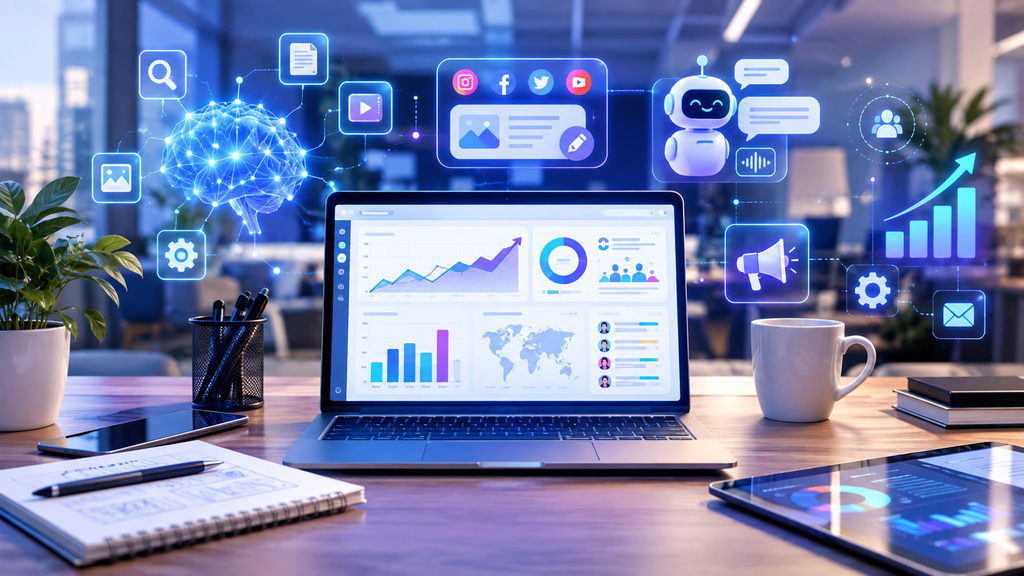
What Is AI in Digital Marketing?
Using artificial intelligence in digital marketing means utilizing its capacities to analyze data, automate, forecast, optimize, and bring improvements to the marketing strategy.
AI is extremely fast and can collect and analyze vast amounts of data, coming up with ingenious ideas along the way. However, human input is still needed to fine-tune the marketing concepts and put the right emphasis on them.
For example, businesses use AI to conduct research and analysis, forecast customer behavior, identify the target audience, come up with advertising ideas, and optimize the website for better visibility.
It is essential to understand that AI does not remove the human factor from marketing. Instead, it enables people to be more productive and creative in their work.
How AI Is Changing SEO
Search engine optimization is one of those fields where artificial intelligence is making a fantastic change. By using AI, marketers can research keywords and search trends, find new angles for content, analyze competitors, and learn what people are looking for online.
This can be extremely helpful for creating an effective SEO strategy. Using the data provided by AI, the marketers can optimize their content, find the best-performing keywords, and improve their websites’ rankings.
However, when it comes to creating content, people are irreplaceable. At least, not yet. The online audience wants relevant, informative, fresh, and high-quality articles. Search engines love value-driven content as well.
While AI can help you get relevant information, make a rough draft, and research search intent, your expertise is needed to provide the right perspective.
AI-Powered Content Creation
Content creation is one of the most critical aspects of any marketing endeavor. In essence, marketers need to come up with fresh ideas, flesh them out into a comprehensive concept or an article, and turn them into various types of content. While the task may seem simple, it is highly time-consuming.
This is where artificial intelligence comes in handy. By analyzing the audience, AI can help develop ideas, provide solutions, create drafts, summarize information, and optimize content.
For example, there is a wide range of AI-powered tools that allow you to generate blog ideas based on the audience and the specified niche. You can also come up with variations of the proposed ideas for different types of content. Marketers can use AI to rework existing material, thereby creating new content from old ones. For example, a blog post can be transformed into a series of social media posts, emails, a video script, etc.
However, even when creating content with the help of artificial intelligence, human intervention is required. Always double-check the information provided by AI algorithms to ensure that it is up-to-date and correct. You may want to supplement the generated content with your own ideas and conclusions to make it more unique and compelling.
Smarter Social Media Marketing With AI
Modern social media marketing is guided by data. By using data analytics, businesses identify what content performs best, who their target audience is, and how they can fine-tune their efforts to get more engagement.
Artificial intelligence makes it possible by providing in-depth insights, assisting with the creation of content, finding the most suitable topics, and automating certain aspects of the social media management process.
For example, by utilizing an AI-powered tool for social media marketing, one can analyze the audience, get suggestions for improvement, see what engagement brings more visibility and growth, and plan content schedules.
This is extremely helpful because, with the data provided by AI, marketers can streamline their efforts, focus on the most promising topics and types of content, and individualize their approach more efficiently.
Personalizing the Customer Experience With AI
Customers want companies to understand them; they want the brand to acknowledge their presence and care about their needs. Artificial intelligence makes it possible by helping the business learn more about the audience and providing personalized recommendations and solutions.
For example, an online store can use AI to suggest products that the customer may be interested in. In short, AI enables marketing personalization, and the ability to do that is extremely valuable in today’s marketplace. By providing a more tailored experience, the business gives the customers what they want and need.
On the other hand, companies need to use customer data responsibly and comply with privacy laws. When used correctly, artificial intelligence can help the business provide a more personalized experience.
AI and Digital Advertising
Digital advertising is another marketing domain where artificial intelligence has made a significant impact. By using AI technologies, businesses can take a data-driven approach to advertising, which is always more beneficial than trial and error. You can automate the process of finding the most effective audiences, keywords, placements, and messaging.
In short, AI helps optimize digital ad spending in a highly efficient manner. Moreover, marketers can rely on AI to free up their time for more critical tasks, such as developing the overall strategy for advertising. However, human input is still required to interpret the data AI provides and make the right choices.
Marketers need to make sure that the information is used correctly and that the advertising messages are appropriate for the target audience. That is why the human factor is still critical to marketing, regardless of how advanced technology becomes.
AI Chatbots and Customer Support
Chatbots are becoming an increasingly popular part of customer support. By using AI, businesses can provide round-the-clock assistance to the customers, answer their questions, and guide them through the website. Chatbots are especially helpful in instances when the customer needs help outside of regular business hours. They can also help reduce the workload for the support team.
But should businesses rely solely on AI for customer support? Definitely not. Chatbots are a helpful addition to human interaction in cases when the customer asks a question that the algorithm knows how to answer.
When it comes to more complex issues, the customers should be directed to a human support agent. After all, the most vital aspect of customer service is building a meaningful relationship where clients feel understood and cared for.
Benefits of AI in Digital Marketing
There are numerous benefits of using AI in digital marketing. The first advantage is that it reduces the time spent on repetitive tasks. AI is perfect for marketing research since it can quickly go through vast amounts of data and find useful information. It can also help with content creation, social media marketing, advertising, and provide data and insights into the customers’ behavior.
Another benefit of artificial intelligence is that it allows for personalization. By using the data about the audience, AI can help create a marketing concept that delivers value to the customers.
Challenges of Using AI in Digital Marketing
While there are many benefits of AI in digital marketing, it is important to acknowledge its disadvantages as well. The biggest issue with AI is that it can provide incorrect or irrelevant information. This is why it is essential to fact-check everything an algorithm suggests. Another pitfall is that using AI means producing generic content. After all, the algorithms are not capable of providing unique perspectives.
Moreover, brands need to use customers’ data responsibly and ensure that their privacy is not violated. Most importantly, AI should only be used as an auxiliary tool in marketing. It is helpful but not invincible.
The Future of AI and Digital Marketing
The future of artificial intelligence and digital marketing will undoubtedly be guided by technology. As more and more companies adopt artificial intelligence, the marketing landscape will continue to change. However, the human factor will remain critical. The most successful strategies will be the ones that combine the capabilities of artificial intelligence with human skills, expertise, ingenuity, and creativity.
Marketers who learn how to use AI to their advantage will likely be more productive and efficient. As a result, they will be able to create more personalized content, better connect with the audience, and become more successful in their endeavors.
After all, the future of marketing is not about creating more content. It is about doing it smarter and using the available tools to better serve the audience and solve their problems.
Conclusion
Artificial intelligence is a powerful tool that is reshaping the field of digital marketing. It is affecting such areas as research, content marketing, personalization, advertising, data and analytics, and customer support. However, those who want to succeed in marketing should know how to use this technology to their advantage.
It is important to embrace AI but not rely on it too heavily. After all, an AI-powered tool is only as good as the person who uses it. A successful marketer needs to combine their talents and skills with the power of artificial intelligence. Only then, will the business be able to harness the full potential of technology and achieve greater success.
Frequently Asked Questions
What is AI in digital marketing?
In the context of digital marketing, AI stands for artificial intelligence. It enables businesses to make the most of their marketing efforts by providing them with data, conducting research, analyzing the audience, automating certain tasks, and offering new perspectives.
How does AI affect SEO?
By using artificial intelligence, marketers can research keywords and search trends, analyze the competition, plan their content strategy, and optimize the website. Moreover, AI can help with search intent, finding new angles for the articles, and suggesting improvements to the content.
Can AI replace digital marketers?
AI can automate many time-consuming tasks, but it is not capable of replacing the human touch and valuable expertise of a professional marketer. Marketers provide the necessary guidance and make the crucial decisions. That is why artificial intelligence is a powerful assistant in the process of marketing but is definitely not a substitute for human skills.
How does AI improve content marketing?
Artificial intelligence helps marketers with generating ideas and suggestions, creating outlines, offering variations of the proposed concepts, repurposing existing content into new ones, and finding the audience’s interests. However, human intervention is required to ensure that the produced content is unique and of high quality.
Is AI useful for small businesses?
AI can be a great equalizer for small business owners. It helps them become more productive and efficient by automating repetitive tasks, analyzing data, and providing solutions and insights. Marketers can also use AI to find new angles for content, better understand the target audience, and offer customers a more personalized experience.
What is the future of AI in digital marketing?
The future of marketing is guided by artificial intelligence. It is expected to have a noticeable impact on various aspects of marketing, including SEO, advertising, content creation, and social media. However, human expertise will remain vital since it is the most valuable asset in marketing.